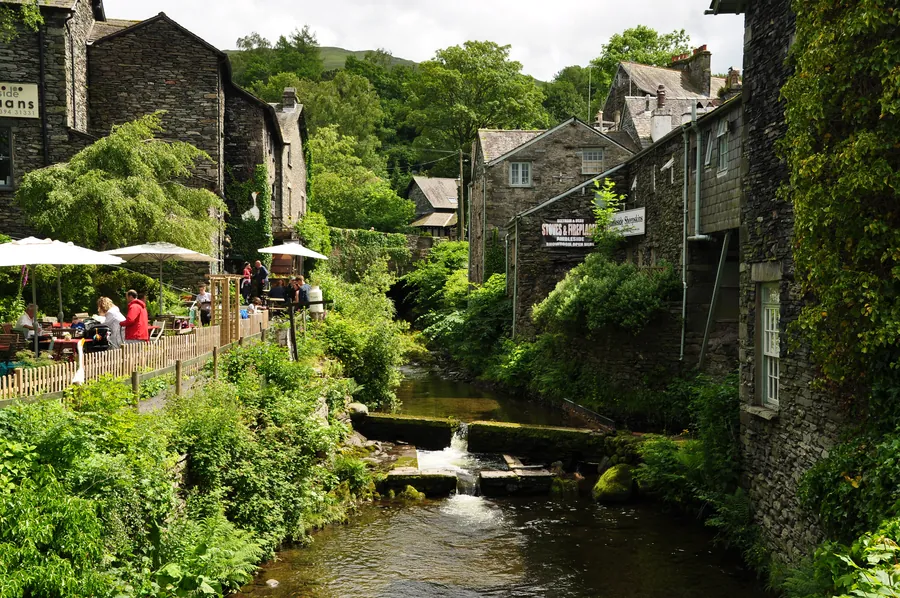
Stock Ghyll Force is a waterfall of about twenty metres in a wooded ravine directly behind Ambleside, eight kilometres north of Windermere. The Lake District has higher falls. What this one has is a fifteen-minute walk from the middle of a town on a made path, and, after rain, a proper two-channel drop into a dark pool with trees closing overhead.
For effort against reward it is the best waterfall you can do from Windermere without a car. It is also a beck, and becks shrink. Come after rain or come for a walk in the woods that happens to have water in it.
Stock Ghyll rises on Red Screes above Kirkstone Pass and runs about six kilometres down through Ambleside to the River Rothay. The name is Old English stocc, a tree trunk, and Old Norse gil, a deep glen. That is still what you walk into.
The fall powered mills — corn, bobbin, fulling — and Ambleside grew around them. Bridge House, the tiny two-room building straddling the same water in the middle of town, is the postcard. The force is the engine. Turner and Ruskin painted the falls; the Victorians laid out the paths and the iron railings you still hold.
It is free, open at all times, and on no one’s ticket. That is why it is busy by eleven. It is also why a lot of “hidden waterfall” copy on the internet is nonsense: you will share the railings, and you should, because a mill-town fall with Victorian iron is a public place, not a secret.
From the middle of town, the lane climbs beside the Salutation Hotel and up Stock Ghyll Lane. The path starts through a gate on the left, marked with a small signpost that people walk past. If you reach the car park at the top of the lane you have gone too far.
From the gate a path climbs through woodland beside the beck, with viewing points, footbridges and a circular route that takes you above the fall and back down the other side.
Time: fifteen to twenty minutes up, about forty-five minutes for the full circuit.
Surface: a made path, with tree roots, loose stone and old iron stanchions from the Victorian steps. It is slippery when wet — which is also when the falls are worth seeing — and it is not suitable for wheelchairs or pushchairs. Benches sit along the way. Most people who can manage a steady uphill walk will manage this.
Stay on the path. The drop into the gill is the point of the railings. In spate you will hear the fall before you see it; that is the cue you are on the right track, and it is also the cue to slow down on the wet stone.
This is the whole advice. Stock Ghyll in spate is a loud, white, two-channel fall. In a dry August it is a stain on a rock. Rain the day before is the difference. Spring for bluebells and wild garlic in the ravine; autumn for colour; winter for full water and, sometimes, ice on the steps.
Early morning is the hour you have it to yourself. Ambleside is a walking town, and this path is on the way to Wansfell Pike. By eleven on a fine day you will have company. After rain you will have company and a waterfall, which is the correct combination.
Do not come in a drought, stand at the rail, and decide the Lakes are overrated. Come back when the becks are loud.
The 555 and 599 buses run to Ambleside in about fifteen minutes. Windermere Lake Cruises land at Waterhead, a kilometre from the town centre — arriving by boat and walking up through Ambleside to the falls is the most enjoyable version of the trip, and it removes parking from the morning.
Driving to Ambleside to see a fifteen-minute waterfall is how you spend forty minutes looking for a space on Stock Ghyll Lane. There is limited roadside parking on the lane and it is not worth the aggravation. Park in a town car park if you must drive, then walk. Better: do not drive.
The Victorian iron is not decoration. The gill is a cleft, the viewing points sit on the edge of it, and wet leaves on wet stone are how people sit down suddenly. Hold the rail. Keep children on the path side of it. Do not climb on the stanchions for a photograph of the pool.
In spate the noise is part of the visit. Spray comes over the lip. Glasses fog. That is the falls working. In drought the same rail looks excessive. Come back.
Ambleside itself: outdoor shops, the Bridge House, the Roman fort at Waterhead. Rydal and Grasmere are up the road if you want Wordsworth after the water. Wansfell Pike starts from the same lane and is the usual first proper fell from Windermere — a different walk, a different day, the same bus.
The falls pair with a boat back from Waterhead, or with Orrest Head only if you treat one of them as a short stop. Two short classics in one day is possible. Two short classics plus a cruise plus lunch is how the waterfall becomes a box to tick.
Our walks guide puts Stock Ghyll among the northern outings. Our free things list puts it where it belongs: no ticket, no hours, no excuse.
Dogs on the path are normal; dogs in the pool are not a good idea and not a kindness to the next child. Keep them on a lead at the railings.
The gate is easy to miss because it looks like a gate into woods, which is what it is. Look for the signpost on the left as you go up past the Salutation. If you have to ask in a shop, you have already walked past it, which is the usual way to find it.
There are no toilets at the falls. There is no café at the falls. Ambleside is fifteen minutes below you and has both.
Stock Ghyll Lane is also the start for Wansfell Pike, the usual first fell from Ambleside: a proper climb, a couple of hours, a view that includes the lake you came from. Doing the force and Wansfell in one outing is a coherent morning if the weather is for it. Doing the force, Wansfell, and a cruise is how the force becomes a pause you resent.
If the high fells are out of bounds, the force is still on. That is a useful fact in a week when the tops are in cloud.
Rain overnight, bus or boat to Ambleside, falls before the town is fully awake, coffee, and either Wansfell or the boat back. Dry week, still go if you want the woods; do not expect a spectacle. Ice on the steps in winter: the same path, slower, and the railings earn their keep.
Do not walk past the gate, reach the lane-end park, and decide the falls were a myth. Do not wear leather soles after rain. Do not treat a trickle in a dry week as a reason to skip every waterfall in the district — wait for weather. Do not fly a drone in a narrow wooded gill full of people on a footbridge.
Stock Ghyll Force is Ambleside’s own waterfall, not a drive-to attraction with a visitor centre. Walk from the town, come when it has rained, and hold the Victorian iron while the beck does what it has done since the mills.