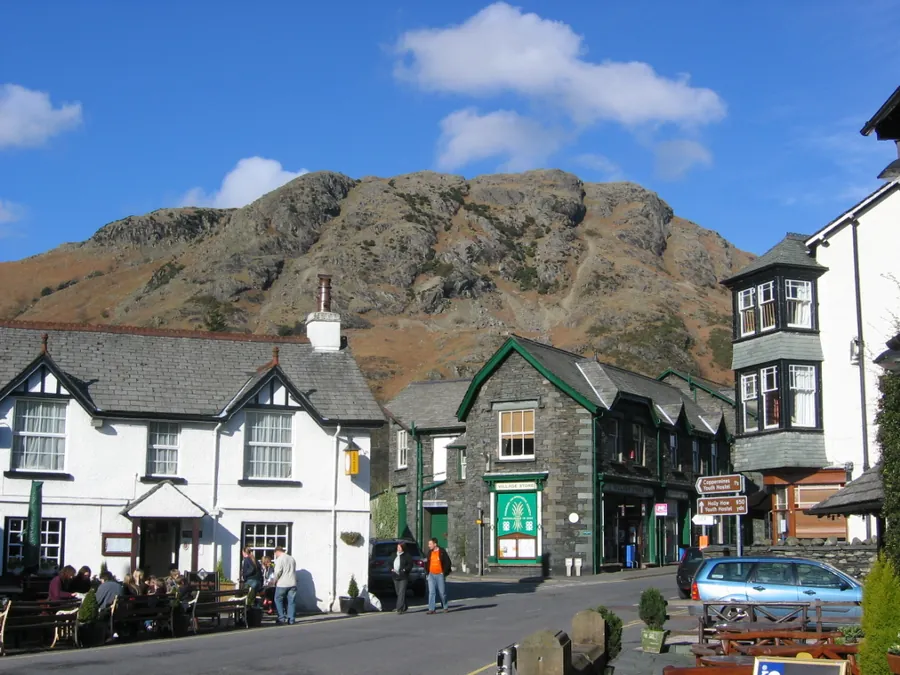
Coniston is a village and civil parish in the Westmorland and Furness district of Cumbria, in the southern part of the Lake District National Park. The 2011 census counted 928 people in the parish, down from 1,058 in 2001: a small place with a large reputation. It sits on the western shore at the northern end of Coniston Water — the third longest lake in the Lake District — at the mouth of Coppermines Valley and Yewdale Beck, with Coniston Old Man behind it. Within the historic county boundaries this was the far north-west of Lancashire, whose highest point was the Old Man.
Two men are the reason most people make the trip. John Ruskin bought the mansion Brantwood on the eastern side of the lake in 1871, rejected the option of burial in Westminster Abbey and was laid to rest in the churchyard of St Andrew’s here instead. Donald Campbell broke four world water speed records on Coniston Water in the 1950s and was killed on it in 1967 on his eighth attempt; his jet boat is now in the village museum. The lake does the rest — hire boats, a National Trust steam yacht, fells rising off the shore.
The straight-line distance from Windermere is 9.6 km.
The Ruskin Museum was established in 1901 as both a memorial to Ruskin and a local museum covering the history and heritage of Coniston Water and the Lake District. It holds 4.5 from 945 Google reviews, and what reviewers write about first is usually not Ruskin. A visitor in July 2026 wrote that “For me the best part was the Donald Campbell area with the historical significance of the tragic speed record attempt on Coniston Lake in 1967”. Another in July 2026 singled out the displays around the record attempts, “including of course Bluebird K7 herself, fresh out of the lake after the recent runs, which is fantastic to get up close to.”
The run that killed Campbell ended in a crash at 290 mph (470 km/h); he had set the record for the seventh time at Dumbleyung Lake in Western Australia in 1964. Divers recovered both his body and Bluebird K7 in 2001, and he was buried in the new graveyard in September 2001. The museum’s new wing, built to take the restored boat, opened in late 2009. Two other graves belong to the village: the philosopher R. G. Collingwood, and the painter Henry Robinson Hall.
Brantwood, Ruskin’s house on the eastern shore, is open to visitors and rated 4.6 from 888 Google reviews. Expect a house museum rather than a great country house: a visitor in July 2026 wrote, “Only a relatively small number of rooms open in the main house, but the display is well done.”
The National Trust’s Steam Yacht Gondola is the highest-rated thing on the water, 4.8 from 457 Google reviews; ferry services across the lake grew up after the National Park was created in 1951. Coniston Boating Centre on Lake Road hires boats and bicycles and holds 4.6 from 1,104 Google reviews. Reviewers agree on the setting and the café, and disagree on the parking. One in June 2026 reported “Ample parking is available.” A visitor in July 2026 put it differently — “there is onsite parking but it is payable” — and warned about timing: “We were there just before the school holidays and it was quite busy so would imagine it gets pretty busy during them.”
The name comes from the Old Norse konungr, king, and the Old English tūn, farmstead or village: the “King’s estate”, and it has been speculated that this was the centre of a small Scandinavian mountain kingdom. By the 12th century it was “Coningeston”. The village grew as a farming settlement and a transport hub for the copper and slate mines above it.
That work has not entirely stopped. Two slate quarries still operate, one in Coppermines Valley and one at Brossen Stone — bursting stone — on the east side of the Old Man, cutting volcanic slates that are blue at Low-Brandy Crag and light green at Brossen Stone. The scenery derives from Coniston Limestone and the Borrowdale Volcanic Group. Coniston Copper Mines carries 4.7 from 109 Google reviews, too small a sample to lean on.
This is hill-walking and rock-climbing country: the Furness Fells, Grizedale Forest, and the eastern face of Dow Crag, 3 miles (4.8 km) out, described as some of the finest rock in the Lake District. Two youth hostels take walkers, one at the village edge, one in Coppermines Valley. Rain is the constant, at almost 2,000 millimetres (79 in) a year.
Coniston is a local centre rather than a resort street: a secondary school named after Ruskin, a primary school, a bank, a petrol station, and a Village of the Year win in 1997. The whole village ran on hydroelectricity in the 1920s until the tax on it forced a return to the national grid; since 7 March 2007 a scheme near the original site has powered up to 300 homes.
Not everything here reviews well. The campsite at Coniston Hall carries 3.6 from 652 Google reviews and splits sharply: a visitor in July 2026 called it an “Absolutely fantastic camp site”, while one in August 2026, who found a shorter booking recorded under another name, wrote of the lakeside setting that “Unfortunately that’s where the positives ended.”
As of March 2026 the main bus service in Coniston is Stagecoach Cumbria’s service 505, which runs to Ambleside and Windermere, and occasionally to Kendal. It is the only public service these sources establish.
There is no train. A branch of the Furness Railway opened to passenger traffic in 1859 and terminated at Coniston railway station — that line, with Ruskin’s arrival, is what turned a mining village into a Victorian destination — but it is described only in the past tense, and no service runs on it today.
If you drive, plan around the parking rather than the distance — reviewers at the boating centre split over how much of it there is, and paying on site is expected. Bikes can be hired at the boating centre and at Bank Ground Farm on the east of the lake, 4.7 from 166 Google reviews.
The village and what is around it, at walking scale.
Open any of them in Google Maps for directions and current opening.
Want live prices and dates? GetYourGuide's booking widget shows them, and sets their cookies in your browser when it loads.
Background on Coniston draws on its Wikipedia article, text there being available under CC BY-SA 4.0.