Windermere is an expensive place to sleep and an inexpensive place to walk. The attractions charge and the accommodation is not cheap, but the lake shore, the fells, the waterfalls, the viewpoints and one of the loveliest tarns in England are all free — and they are the reason people come.
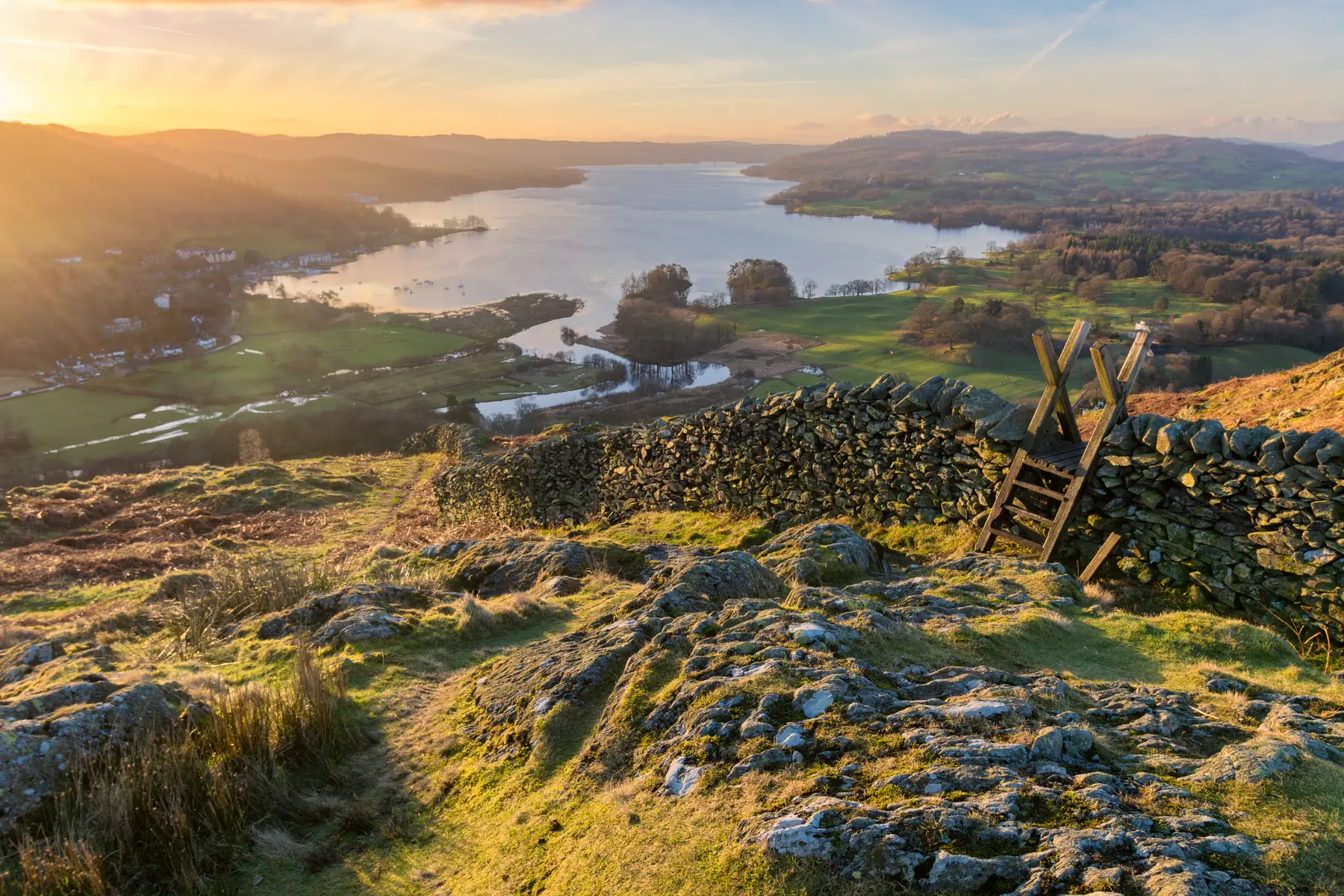
The best free thing in the southern Lake District. A path leaves the A591 directly opposite Windermere station and climbs for twenty minutes through woodland to a rocky top at 238 metres, with the whole lake below and the Coniston fells, the Langdales and Scafell beyond.
It is where Alfred Wainwright stood in 1930 on his first visit to the Lakes and decided what to do with his life. There is a bench and a viewfinder at the top. Forty-five minutes round trip, and free.
School Knott, east of the town, is the quieter equivalent.
Windermere’s shores are more accessible than most Lakeland lakes.
Cockshott Point at Bowness is National Trust — an open field running down to the water, free, with a shingle beach and swans.
Millerground, north of Bowness, has a small beach and woodland, and the shore path north to Brockhole is free and level.
Brockhole’s grounds — the national park visitor centre’s gardens, dropping through terraces to the lake — are free to walk in; only the activities charge. It is one of the better free afternoons here.
Fell Foot at the southern end is National Trust: lakeside parkland with a beach and grass, free to members, charged parking for everyone else.
Rayrigg Meadow between Windermere and Bowness is open, free and used for swimming.
Reached by the Windermere ferry — a chain ferry from Bowness that costs very little and takes a few minutes — and the west shore is where the lake gets quiet.
Claife Viewing Station, restored by the National Trust, is a Georgian folly built so that eighteenth-century visitors could look at the lake through coloured glass, each pane suggesting a different season. It is free and the view is still the point.
The paths through Claife Heights and along the western shore run for kilometres through woodland with the lake below and almost nobody on them.
Latterbarrow, above Hawkshead, is a short free climb to one of the best views in the southern Lakes.
Stock Ghyll Force at Ambleside, eight kilometres north — a twenty-metre fall in a wooded ravine, fifteen minutes’ walk from the town centre, free, and at its best after rain.
Rydal Cave, near Ambleside, is an enormous quarried cavern you walk into across stepping stones. Free and unexpectedly dramatic.
Skelwith Force near Elterwater and Colwith Force in Little Langdale are both short free walks.
Above Hawkshead, National Trust, and one of the most photographed places in England: a tarn ringed with conifers and fells, with a level surfaced path all the way round — about three kilometres, accessible to wheelchairs and pushchairs.
The walking is free; the car park is not, and it fills by mid-morning in season.
Free, all of them. The Lake District’s fells are open access, and from Windermere the nearest are:
Wansfell Pike above Ambleside, three hours round, and the usual first fell from here.
The Fairfield Horseshoe from Ambleside, a full day and one of the classic Lakeland rounds.
Loughrigg Fell above Rydal, short and with a view out of all proportion to its height.
The Coniston fells and the Langdale Pikes, both within half an hour by road.
Our walks guide has the routes.
Bowness and Ambleside cost nothing to walk round. Ambleside has the Bridge House — a tiny two-room building straddling a beck, one of the most photographed structures in the Lakes — and the free-to-see remains of the Roman fort at Waterhead.
Hawkshead, across the ferry, is a village of whitewashed cottages and squares, free to wander, with Wordsworth’s old grammar school and the Beatrix Potter connections.
Grasmere, half an hour north, has Wordsworth’s grave in the churchyard, free, and the gingerbread shop next to it.
Red squirrels survive in the woods around Windermere and Claife Heights — this is one of their English strongholds.
Ospreys at Bassenthwaite and red deer on the higher fells.
Herons, goosanders and swans all along the lake shore, and Arctic charr in the deep water, a relict fish left behind by the last ice age and found in only a handful of British lakes.
Parking, and the attractions if you want them. National Trust car parks at Tarn Hows, Fell Foot and along the shore are free to members, and an NT membership pays for itself quickly in this county.
Windermere station is the end of a branch line from Oxenholme on the West Coast main line, and the 555 bus runs the length of the A591 through Ambleside and Grasmere to Keswick — so a car-free stay works well, and the bus journey along Rydal and Grasmere is worth the fare on its own.
Start with Orrest Head first thing — twenty minutes up, and the whole lake below you. Walk down through Windermere to Bowness and take the ferry across to the west shore. Walk north along the shore path to Claife Viewing Station for the view through the coloured glass, and on through the woods.
Come back on the ferry, walk the shore north from Bowness through Cockshott Point and Millerground to Brockhole, and sit in the free gardens with the lake in front of you.
A viewpoint that started a walking movement, a Georgian folly, a chain ferry and three kilometres of lake shore, for the price of a ferry ticket.
The first free day covered the lake. The second should go up. Take the bus to Ambleside and walk Stock Ghyll Force — fifteen minutes to a twenty-metre waterfall — then continue up Wansfell Pike, three hours round trip, with the whole lake below you at the top. Come down into Troutbeck and take the bus back.
Or go north on the 555 to Rydal and Grasmere: the Coffin Route between them, Loughrigg Terrace for the classic view down Grasmere, Rydal Cave, and Wordsworth’s grave in the churchyard — all free, and one of the best days in England.
Worth the arithmetic. The Trust owns an extraordinary share of this landscape: Tarn Hows, Fell Foot, Claife Viewing Station and the west shore, Wray Castle, Hill Top, the Beatrix Potter Gallery, Sizergh and a long list of car parks.
The land is free to everyone; membership buys the parking and the houses. For a week based in Windermere with a car, it pays for itself in about three days.
Orrest Head, twenty minutes from the station, for the view that made Wainwright a fell-walker.
Yes, the gardens and grounds are free to walk in. The adventure activities and the parking charge.
The walk is; the National Trust car park is not, and it fills early in season.
Millerground, Cockshott Point, Rayrigg Meadow and Fell Foot are all used for swimming. The water is cold year-round.
No — the Windermere chain ferry to the west shore costs very little for foot passengers and is one of the best value few minutes in the Lakes.