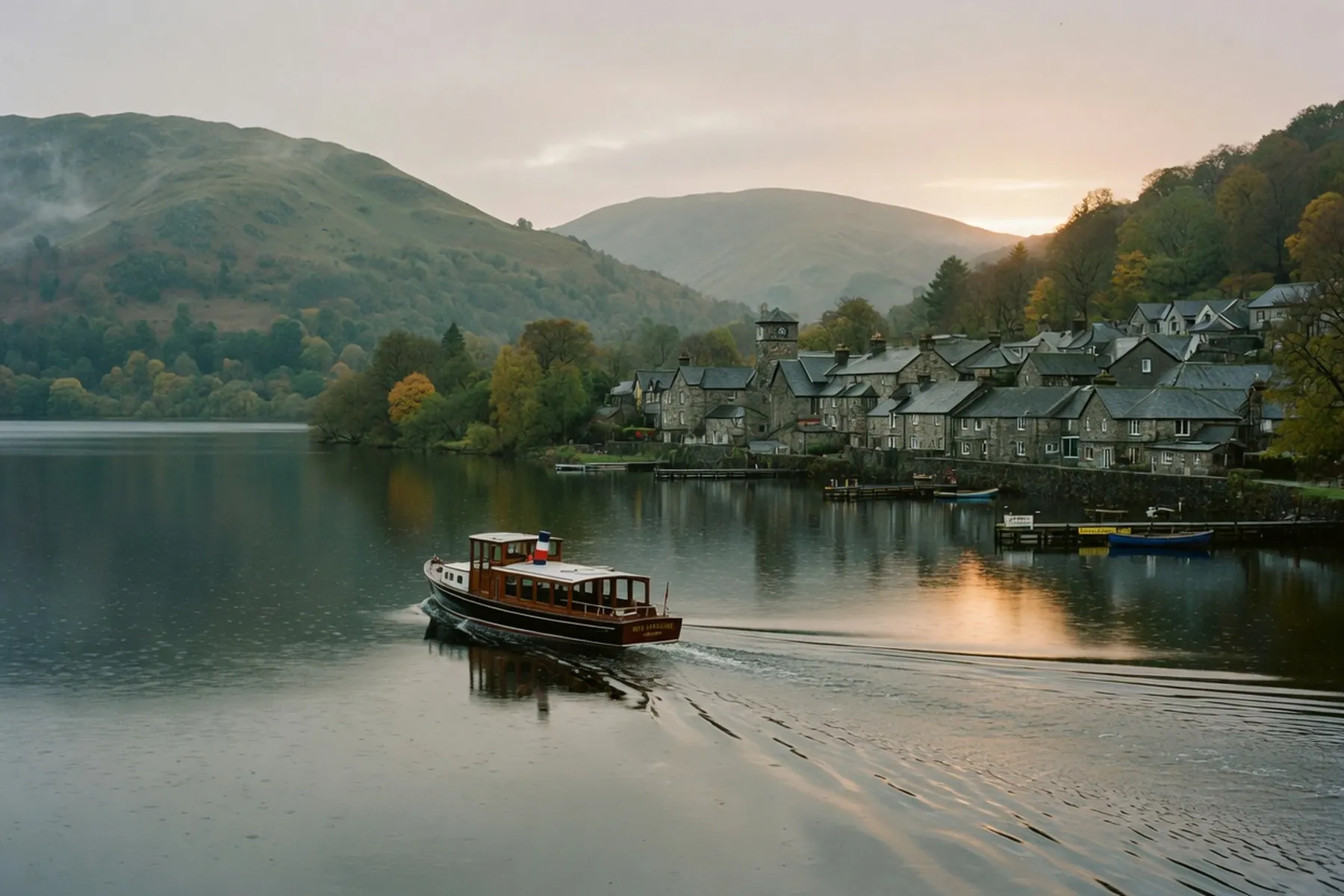
Ambleside is the day out most visitors to Windermere plan and then half-do, because they treat the journey as trivial and step off at Waterhead with no sense of what is in front of them. It is not far. A Red Cruise launch does Bowness to Waterhead in 35 minutes; the 599 or 555 bus does Windermere to Ambleside in about ten to fifteen minutes in normal traffic. The town itself is a compact knot of Bridge House, a Roman fort, England’s tallest trees and a waterfall, and almost all of it is a flat walk once you are off the pier. The thing to plan around is the calendar, not the map. The launch fares quoted here are valid 28 March to 1 November 2026, and the bus that is frequent through the summer thins to roughly hourly after that same date.
Ambleside is the counterpoint to Bowness: a working market town on the fell side, not a resort on the shore. What makes it a good day from Windermere is density. Bridge House sits over Stock Beck in the middle of town, the ruin of a 2nd-century fort stands a few minutes’ walk from the pier, Skelghyll Woods above the town hold England’s tallest trees, and Stock Ghyll Force is a short path up from the centre. You do not need a car between any of it. Do not attempt a full walking route along the A591 corridor from Windermere village without checking the distance yourself; the corridor is longer than it looks, so treat the day as launch or bus, not a stroll.
The Red Cruise runs Bowness to Ambleside Waterhead — 35 minutes one way, 75 minutes for the return — and it is the scenic version of the commute. Return fares on the operator’s page are valid 28 March to 1 November 2026: £19.20 for an adult, £11.60 for a child aged 5 to 15, £55.00 for a family of two adults and up to three children, with under-fives free. Well-behaved dogs travel free. Tickets work all day as hop-on/hop-off, and the red-marked launches also call at the Windermere Jetty Museum and Brockhole, so the day can be broken into legs without doubling back. For the routes and boats themselves, the full cruises article has it.
Bowness pier is LA23 3HQ, two minutes from the village and the closest pier to Windermere town — ten minutes by bus or car, 25 on foot — with more than 400 parking spaces. At the far end, Waterhead pier LA22 0EY has a small pier car park and more than 200 pay-and-display spaces within five minutes’ walk.
Two routes cover the run. The 599 “Lakesider” works Windermere and Bowness to Ambleside and Grasmere, open-top in summer; the 555 “Lakes Connection” is the year-round spine from Kendal through Windermere and Ambleside to Keswick. Both stop at the Windermere rail and bus interchange and in the Kelsick Road area of Ambleside.
The figures that follow come from an independent route guide, not from Stagecoach, so treat them as shape rather than timetable. In the summer season, 23 March to 1 November 2026, the 599 runs roughly every twenty minutes through the day; in winter it drops to roughly hourly. The 555 runs roughly every half hour in the daytime, Monday to Saturday. After 1 November the 599 thins sharply. Stagecoach’s own pages are the place for live times — check stagecoachbus.com or the app, and do not build the day around a departure time you cannot verify.
The pier lands you at Waterhead, and the walk into Ambleside is flat, about half a mile. Before you start it, Borrans Park is right there: a council-managed grassed recreation ground at LA22 0HJ with picnic benches and lake views, reached from the A591. Beside it, the remains of a Roman road run toward the fort, with interpretation in the adjacent field. Public Space Protection Orders can apply here for dog fouling and anti-social behaviour — a noticeboard thing, not a trap, but worth knowing if you are bringing a dog.
Bridge House is the postcard shot, a 17th-century cottage built over Stock Beck at LA22 9AY, and it is also the fact most guides now get wrong. You can stand beside it and photograph it freely, but you cannot walk through it as a visitor any more. The National Trust notes limited access, and the interior now belongs to the Armitt’s “The Bridge House Mystery — Escape Box Experience”. If going inside matters to you, book through the Armitt rather than turning up. The market streets around it are the contrast to Bowness: a town that carries on regardless of the pier timetable. For the full town, see the Ambleside page.
A few minutes’ walk from the pier, the fort at Galava is free and open any reasonable time during daylight hours. English Heritage dates it to the 2nd century, built under Hadrian’s rule to guard the Roman road from Brougham to Ravenglass and to act as a supply base; the site itself is managed by the National Trust. There is no on-site parking — use the charged public car parks in Ambleside — and dogs must be on leads. The operator lists a sheer drop, uneven surfaces and livestock among the hazards, and bans smoking, vaping, barbecues and naked flames. A free Bloomberg Connects digital guide covers the site. If Roman-industrial Lakeland turns out to be your thing, English Heritage also points to Hardknott Fort, Ravenglass Bath House and Stott Park Bobbin Mill for a wider day.
The free National Trust stop is Stagshaw Garden, open dawn to dusk when checked on 18 September 2026, with a small car park of about eight cars and dogs on leads. Just above it, Skelghyll Woods holds England’s tallest trees — the tallest Grand Fir was measured in September 2024 — and the Champion Tree Trail runs through them. The garden and woods share the postcode LA22 0HE. The Trust’s getting-there note is the useful bit for the car-less: the 555 or 599 to Waterhead, then a short walk, or the ferry from Bowness to Waterhead in the main season and then about a mile, 1.6 kilometres, on to Bridge House.
The waterfall is the reward after wet weather, and the full article on it covers the fifteen-minute path from town and why a dry August is a let-down. The short version for a day trip: go after rain, and do not make it the centrepiece of a hot, dry week.
The Armitt Museum & Library on Rydal Road is where the town’s history concentrates — Roman artefacts from the fort and Beatrix Potter’s watercolours among them. Its own visiting page is thin on practical details, so I will not quote a price or an opening time here; check armitt.com before you walk over. The museum also runs talks and workshops through autumn, which is the better reason to check that page in advance.
The one fixed date is the Ambleside Christmas Lights switch-on, Saturday 21 November 2026 — community-run and donation-funded, with a switch-on parade, Santa Cruises and a lantern parade. This year it goes ahead without fireworks, the organisers citing rising costs and insurance. Times live on the organisers’ map-of-events page, so check amblesidechristmaslights.com rather than a listing. Through autumn there is also a weekly outdoor market on Wednesdays on King Street car park; check the board in town or the market’s own listings for a given week.
The hop-on/hop-off ticket is what turns Ambleside into a loop rather than a there-and-back. Launch from Bowness, walk the town, then either ride back on the red route and drop in at Brockhole or the Jetty Museum on the way, or take the bus home up the A591. That way the launch is transport twice over, and the day does not hinge on one return sailing. Both piers have parking, so the car-versus-launch decision is genuinely either/or.
Fares and frequencies on both the launch and the 599 move on 1 November 2026. The Red Cruise return fares above are valid to that date, and the 599’s summer book ends then too; after it, expect roughly hourly buses and check Stagecoach before you rely on a connection. Parking exists at both ends — more than 400 spaces at Bowness pier, a small pier car park and more than 200 pay-and-display spaces at Waterhead — but it is pier-adjacent parking, and it fills in school holidays the way everything else here does. For launch times, check the operator’s own page before you set out.