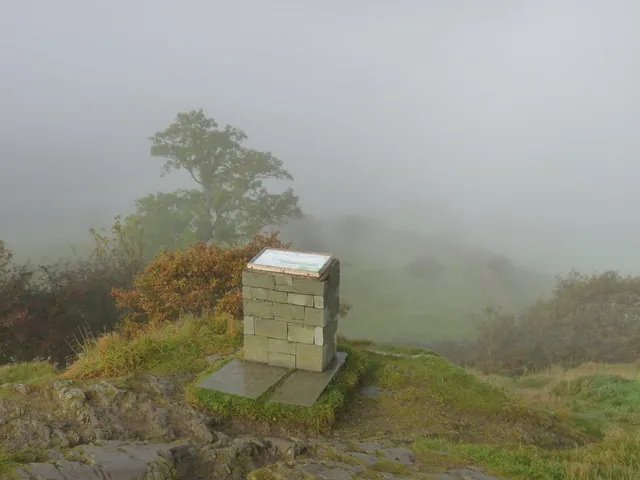
Orrest Head is a rocky knoll of 238 metres immediately behind Windermere town, and it is the most important small hill in the Lake District. The climb takes about twenty minutes from a gate on the A591 directly opposite the railway station, the path is good the whole way, and the view from the top takes in the full length of Windermere, the Coniston fells, the Langdale Pikes and — on a clear day — the Scafell range beyond.
For the effort involved there is nothing else like it in England.
In 1930 a twenty-three-year-old borough treasurer’s clerk from Blackburn came to the Lake District for the first time on a week’s holiday, walked up here from the station, and looked at the view. Alfred Wainwright later described the moment as the one that shaped the rest of his life. He went on to compile the seven handwritten Pictorial Guides to the Lakeland Fells, which remain the most influential walking books ever published in Britain and which sent several generations up these hills.
The summit now has a bench, a viewfinder identifying the fells, and a plaque quoting him. It is a pilgrimage of sorts, and it is a genuinely good view regardless of whether you have read a word of him.
The path leaves the A591 through a gate a couple of minutes’ walk from Windermere station, climbs through woodland on a broad track, and emerges onto open ground near the top. There is a short rocky scramble to the summit knoll itself, which most people take at a walk.
Time: about twenty minutes up, forty-five minutes round trip with time at the top.
Ascent: roughly 130 metres from the road.
Surface: a made track for most of the way, with rougher ground and rock at the summit. It is not wheelchair accessible, but it is comfortably within reach of anyone who can manage a steady uphill walk, and children do it easily.
There are two routes up, one gentler than the other, and both are signposted from the road.
The whole of Windermere below, running away south towards Lakeside. Belle Isle in the middle of it. The Coniston fells and the Langdale Pikes across the water to the west, the Fairfield group and Red Screes to the north, and the Yorkshire Dales hills away to the east.
It is a genuine 360-degree view, which is unusual for a hill this size and this close to a town.
Dawn and the last hour before sunset are the best light from the knoll, when the lake is a sheet. In winter, on a cold clear day, the visibility is better than at any other time of year and the summit is often empty.
On foot: from Windermere station or the town centre, cross to the A591 and look for the signposted gate opposite. Everything in Windermere town is within ten minutes of the start.
By train: Windermere is the terminus of the branch line from Oxenholme on the West Coast main line, with services roughly hourly. This is the closest thing the Lake District has to a fell you can climb directly from a railway platform.
By car: there is no dedicated car park. Use the town car parks and walk, which takes a few minutes.
By bus: the 555 and 599 both stop in Windermere town.
There is nothing at the top — no café, no facilities, no shelter. It is open ground and it catches the weather.
The path is muddy after rain and the summit rock is slippery when wet.
It is free, it is open at all times, and it is one of the very few places in the Lake District where you can arrive by train, climb a hill and be back for lunch.
About twenty minutes up and forty-five minutes for the round trip, from a gate opposite Windermere station.
No. It is a steady uphill walk on a made path with a short rocky section at the summit, and children manage it easily.
No. It is open access land, free, and open at all times.
Because Alfred Wainwright climbed it on his first visit to the Lake District in 1930 and described the view as the moment that changed his life. He went on to write the Pictorial Guides that shaped how Britain walks in these hills.
Very nearly — the view runs the length of Windermere with the Coniston fells and the Langdales beyond, and it is a full circle from the summit.