Hill Top at Near Sawrey is listed twice in most guides — once as a National Trust property and once as Beatrix Potter’s house — and the two descriptions cover the same low farmhouse across the lake from Bowness. This page takes the second half: not how to visit, which is covered on our Hill Top page, but who she actually was, because the version most visitors arrive with is a good deal smaller than the truth.
Before she was an author she was a scientist. Beatrix Potter was a serious amateur mycologist, painting fungi with a precision that specialists still use, and she developed a theory about the germination of fungal spores that she wrote up as a paper.
In 1897 that paper — On the Germination of the Spores of Agaricineae — was presented to the Linnean Society. She could not present it herself, because women were not admitted, so it was read on her behalf. The Society issued a posthumous apology in 1997.
Her natural history watercolours are held at the Beatrix Potter Gallery in Hawkshead, along with the book illustrations, and they are the part of the collection that surprises people.
The Tale of Peter Rabbit began as an illustrated letter to a sick child in 1893. She published it privately in 1901 after several rejections, and Frederick Warne took it the following year. The books were a commercial success on a scale that was unusual then and would be unusual now, and she managed the commercial side herself — she registered a Peter Rabbit doll in 1903, which is generally reckoned to be the first licensed literary character merchandise.
The money bought Hill Top in 1905, and Hill Top is where most of the later tales were written and drawn.
This is the part that gets left out. From the 1920s onwards Potter bought farm after farm in the central Lake District — Troutbeck Park in 1923, and eventually fifteen working farms and over four thousand acres.
She farmed them properly. She bred Herdwick sheep, the hardy grey fell breed native to these hills, showed them successfully at agricultural shows, and was elected president of the Herdwick Sheepbreeders’ Association shortly before her death — the first woman to hold the post, and by then far better known locally as a farmer than as an author.
She bought partly for love of the landscape and partly with intent. Land was being sold for development, and she was buying to stop it.
When she died in 1943 she left everything to the National Trust: the farms, the land, the flocks and Hill Top itself, on condition that the Herdwick sheep continued to be grazed on the fells.
They still are. That bequest is the single largest reason the central Lake District looks the way it does, and the farming system it protected — hefted Herdwick flocks on common fell — is a substantial part of the case on which the Lake District was inscribed as a UNESCO World Heritage Site in 2017.
Her mentor in all this was Canon Hardwicke Rawnsley, vicar of Wray, whom she met on a family holiday at Wray Castle in 1882 when she was sixteen. Rawnsley was one of the three founders of the National Trust. That one holiday, in other words, produced both the books and the land.
Hill Top at Near Sawrey — the house, by timed ticket.
The Beatrix Potter Gallery at Hawkshead — her original artwork, in her husband’s former solicitor’s office.
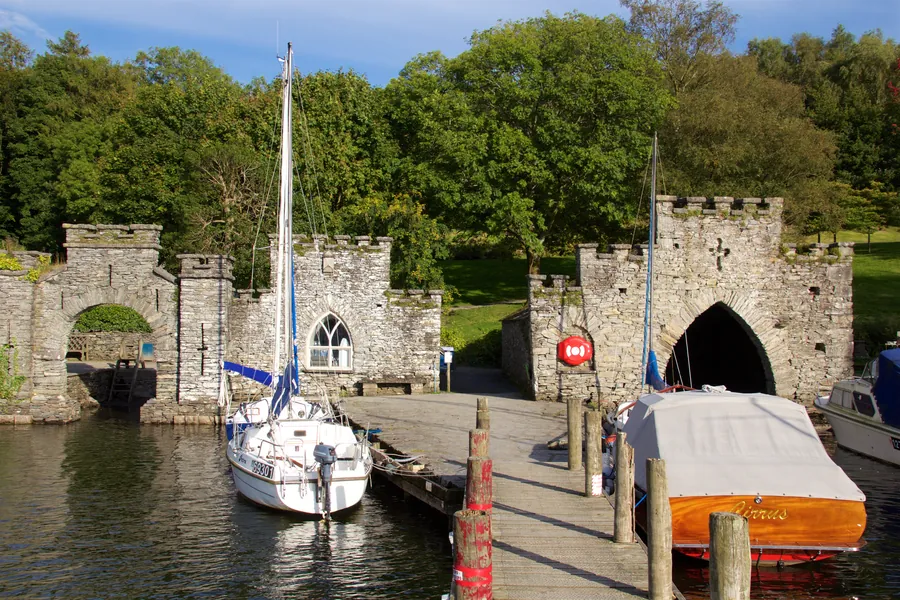
Wray Castle on the west shore — where the sixteen-year-old first came to the Lakes.
The fells above Troutbeck and Coniston — the farms themselves, free to walk on, with the Herdwicks still on them.
Our Beatrix Potter guide puts the whole trail together.
Yes. Her paper on fungal spore germination was presented to the Linnean Society in 1897, and her mycological watercolours are still admired for their accuracy.
Over four thousand acres and fifteen working farms, on condition that the Herdwick flocks were maintained on the fells.
Actively, and successfully. She bred Herdwick sheep and was elected president of the Herdwick Sheepbreeders’ Association shortly before her death.
At the Beatrix Potter Gallery in Hawkshead, which holds a rotating selection of her book illustrations and natural history paintings.
Yes — the same farmhouse at Near Sawrey, listed under two names. Our Hill Top page covers visiting it.