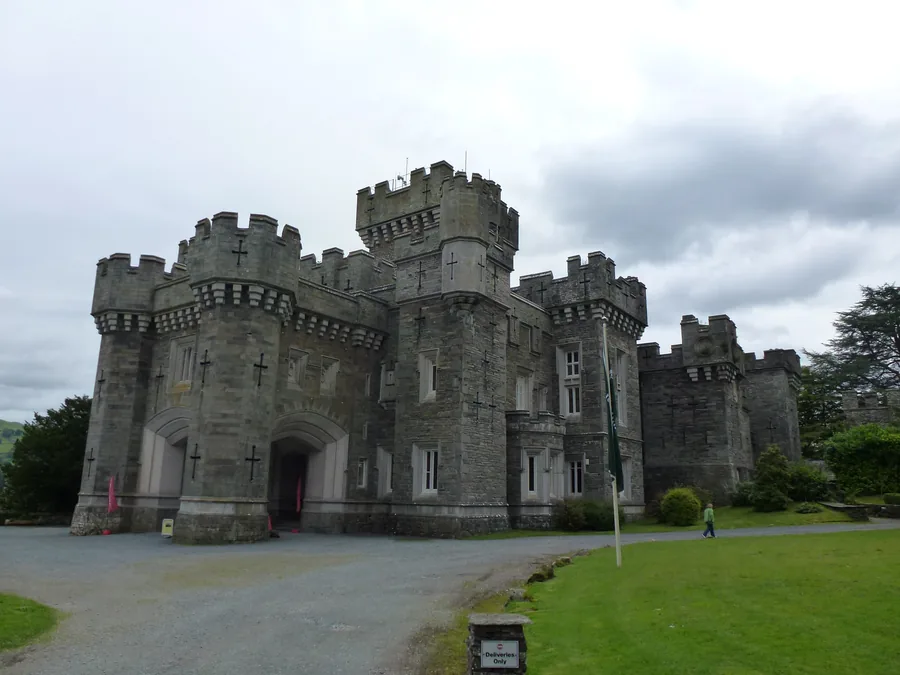
Wray Castle stands above the western shore of Windermere, and it is not a castle. It is a large Victorian house built in 1840 in mock-Gothic — battlements, turrets, a porte-cochère — for a retired Liverpool surgeon named James Dawson, paid for with his wife’s inherited gin fortune. The story locally is that she disliked it and refused to live there.
The National Trust has owned the estate since 1929. The important fact for anyone planning a visit now is simpler than the architecture: the house is closed for refurbishment. The Trust’s own pages have described the interiors as shut while the grounds, café and parkland stay open. Check the National Trust Wray page before you travel. Do not arrive expecting furnished rooms, dressing-up, or a castle tour.
The visit that remains is a good one: lawns to the lake, specimen trees, a shingle beach, a jetty, and the quiet shore. It is not the visit the older guidebooks describe. If a listing still talks about dressing-up in the great hall as if you could do it this afternoon, it is out of date — including, until they are revised, older pages on this site.
For about a dozen years before 2024 the Trust opened the interiors and leaned into the emptiness. Most of the original contents were long gone; rather than fake a country-house interior they used the rooms for family activities and exhibitions and let the vaulted hall speak. Families liked that. Adults who wanted mahogany sometimes did not.
None of that is on offer while the building is in refurbishment. The architecture is still there from the outside: castellated towers, arrow slits, ruined-looking battlements on a house that was never a fortress. You can look at it. You cannot currently go in.
When the house reopens, the Trust will say so. Until then, plan for the grounds.
The estate runs down to the water. Wide lawns, woodland paths, waymarked trails from the front of the castle, and a long stretch of shingle on England’s largest lake. The views across to the eastern fells are the reason Dawson put the house where he did.
The trees are part of the show. Victorian Lakeland villas collected exotic firs; Wray has sequoias from the 1840s, cedar, beech, veteran oaks. Local tradition says Wordsworth planted the mulberry in 1845. Believe the tree; treat the attribution as tradition.
Joey’s Café, independently run, serves the usual Trust-adjacent coffee and cake. Dogs on leads are welcome in the grounds and in the café. The Trust rates the place three pawprints. There is a water station and a stick store. Treats at the café.
A Gothic Revival boathouse and a miniature harbour sit on the shore — one of the larger boathouses on the lake, and the proper entrance if you arrive by water. An all-terrain tramper scooter is available to hire; there is level access around the outside of the castle, Blue Badge parking in the top car park, and a disabled toilet near the café.
Pages from the Potter Family Album — Rupert Potter’s photographs, Beatrix’s father — has been shown on outdoor panels in the garden. Outdoor exhibitions come and go; the lake does not.
In 1882 the Potter family took Wray Castle for a holiday, and the sixteen-year-old Beatrix saw the Lake District for the first time. During that stay they met Canon Hardwicke Rawnsley, then vicar of Wray, later one of the three founders of the National Trust. His conservation politics are a large part of why Potter bought farms and left them to the nation.
So the summer that led to the books also led to the land. Hill Top, across the lake, is the house she made. Wray is the house she first stood in. You cannot currently stand in it. You can stand on the lawn she walked down to the water.
St Margaret’s Church at Low Wray, built by the same owner, is a short walk. The church and the house were one estate; the Trust now looks after the parkland, and the parish looks after the church. Neither is a reason to skip the shore.
Windermere Lake Cruises’ Green Cruise calls at Wray jetty from Ambleside in season. From the jetty it is a short walk up the lawn. That is the correct arrival: no lane, no JustPark, the house appearing above the trees as it was meant to.
The chain ferry from Bowness to Far Sawrey, then a walk or cycle along the west shore, is the other water-adjacent route — about four miles from Ferry Head. The Trust also describes a six-mile drive via Hawkshead from the ferry if you have the car on board. The ferry itself runs a limited daily service; check it.
From Hawkshead a bridleway of about three miles. From the 505 bus (Kendal–Coniston, also useful from Ambleside and Windermere) it is a twenty-minute off-road walk from the nearest stop. That is the car-free version without a boat.
The road in is single-track. The car park does not take campervans or minibuses. Payment is by machine or the JustPark app, code 80715. National Trust members park free by scanning a membership card at the machine. Non-member charges are listed on the Trust page and on the machine; they change, so do not rely on a figure you memorised. Download JustPark before you have no signal in the lane.
In season the boat is the better idea. The lane is the reason.
The west shore paths run north towards Ambleside and south towards the ferry. Claife Heights sits above. Latterbarrow is a short climb if you have come from Hawkshead. Wray works as the start or finish of a shore walk, which is a better use of a closed house than staring at a locked door.
Forty-five-minute “Walk and Talk” tours of the grounds run when the Trust staffs them. Book if you like a story; the paths are open without one.
If you came because a guidebook said Wray was the historic house where children could run about, read the Trust page again. That visit is the one in refurbishment. What you have instead is a large garden, a beach, a café, and space. For many families that is the better half anyway. For families who needed the indoor rooms on a wet Tuesday, it is not — pick the Jetty Museum or Brockhole instead, and put Wray on a dry day.
When the house reopens, the old advice about empty rooms and dressing-up may or may not still apply. Trust the current listing.
Spring is the trees coming in. Summer is the jetty at its most useful and the car park at its least. Autumn is the parkland. Winter is the grounds in weather, the café if it is open, and a boat service that may have thinned. The west shore is quieter than Bowness in every season. That is the point of crossing the water.
Do not come for the interiors until the Trust says they are open. Do not bring a motorhome and expect a space. Do not treat “grounds only” as a consolation prize — the lawn and the jetty were always half the visit, and for some of us they were the better half.
Wray is a Victorian joke about medieval England, on a lawn that still works. Come by water, walk the shore, look at the battlements from outside, and check the National Trust page for the day the doors open again.