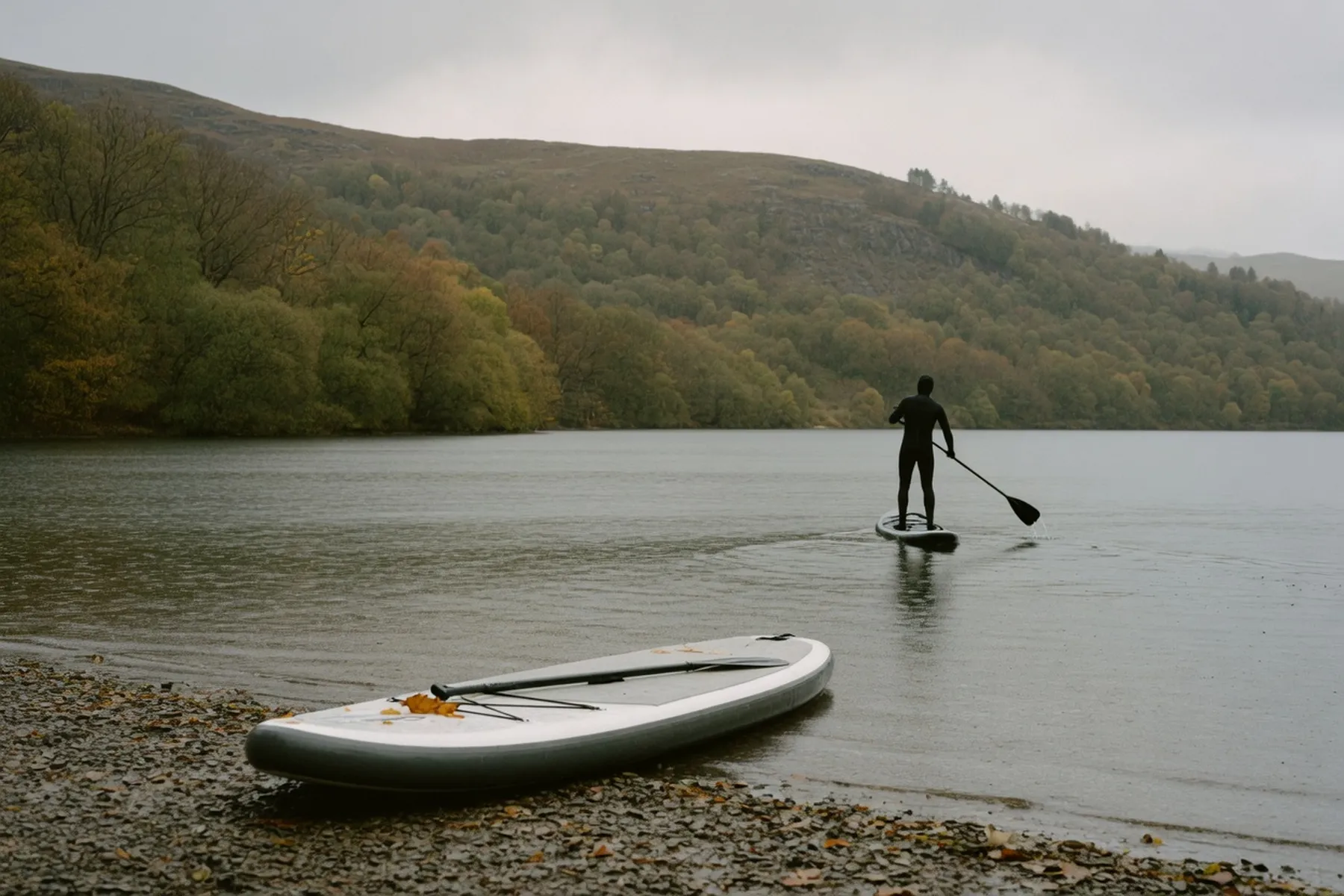
Windermere is the rare lake you can simply walk into: the whole of it is open to swimmers and paddleboarders, and the rules are fewer than most first-timers assume. No permit is needed to put a paddleboard on the water — registration exists, but only for powered boats — and the limits that do bind you are about speed, visibility and where the boats run, not about buying access. The honest complication is the cold and the season. The water stays cold even in summer, and every hire centre on the lake closes its doors at the end of October.
Swimming is allowed on Windermere, with no general ban, but the Lake District National Park Authority asks you to swim along the shoreline rather than out in open water, so you stay out of the boat paths. Four stretches of the lake are formally designated bathing waters, monitored by the Environment Agency between May and September: Rayrigg Meadow, Millerground Landing, Lakeside YMCA and Fell Foot. These are the places where water quality is checked on a published schedule, and they are the natural first choices for a swim.
The places to stay out of are not on Windermere at all. Swimming is not allowed in Ennerdale Water, Haweswater, Thirlmere or the Kentmere reservoirs, which are drinking-water stores rather than recreation lakes. On Windermere itself the practical exclusions are jetties, marinas and ferry routes, which the Swim Safe Code tells you to avoid.
“Designated bathing water” is a formal label with a specific job: it means the Environment Agency samples the water for bacteria during the bathing season and publishes a classification. The four Windermere sites have been rated Excellent every year since 2015, including 2025. That is a genuine reassurance, but it has a boundary worth knowing: the classification does not cover blue-green algae, which appears in localised blooms that monitoring is not designed to catch. Treat the rating as a reason to swim, not a reason to stop checking.
The thing nobody tells first-time swimmers is how little the lake warms up. Windermere stays cold even in summer, and cold-water shock — the involuntary gasp when you first get in, which can pull water into your lungs — is a real risk at any time of year. The National Trust warns visitors to Fell Foot that autumn and winter bring higher water levels and tougher conditions, and that the cold is the first hazard, not the last. Enter slowly, walk in rather than jumping, and let your breathing settle before you start to swim. A wetsuit does two jobs at once here: it keeps you warm and it adds buoyancy.
Blue-green algae, or cyanobacteria, is the one water hazard the Excellent rating will not warn you about. A bloom can cause a rash or illness if the water is swallowed, and it is lethal to dogs, which drink from the shallows where it gathers. Blooms are localised and temporary, so the check is simple: look for a green scum or paint-like film on the surface before you go in, read the signs at the shore, and check the Environment Agency map. If you find one, report it through the Bloomin’ Algae app or on 0800 80 70 60, and keep your dog out of the water entirely that day.
The Swim Safe Code the national park publishes is short and worth knowing whole. Never swim alone; no alcohol or drugs before you get in; enter slowly and check the depth by walking in; plan an easy exit before you start; swim near the shore; and only go in weather that suits your ability. On a busy lake the extra rules are about being seen: a bright cap and a tow float, and ideally a support craft alongside you. There is no lifeguard at Fell Foot, or anywhere else on the lake, so the person watching you is whoever you brought.
Windermere is governed by the LDNPA’s Windermere Navigation Byelaws, and the first thing to know is that they are written in knots, not miles per hour — the byelaws’ “miles per hour” means nautical miles, where one knot is 1,852 metres. Powered vessels are limited to 10 knots across most of the lake, but four zones drop every vessel, powered or not, to 6 knots: the water north of Wansfell Boathouse and Green Tuft; White Cross Bay; Bowness Bay and the water around Belle Isle, plus the Ferry Landing to Ferry Nab crossing; and the southern reach below Ringing Crag. If you paddle in one of those zones, you are inside the slow water where the boats are also most careful. Outside them, a paddleboard has no speed limit of its own.
Registration is the rule people misremember. It applies only to power-driven vessels — anything with an outboard, an electric motor or other mechanical propulsion, in use or moored, private or commercial. Paddleboards, kayaks, canoes and engineless sailing boats are exempt, so a paddleboarder never registers. If you do own a powered boat, registration costs £48 for a new vessel and £36 to renew, and it is not complete until the numbers are displayed on both sides of the hull; allow ten days for them to arrive. Powered launching is restricted at Waterhead beach, between the cruise pier and the Wateredge Hotel boundary. Lake Rangers patrol, film and use radar to enforce the limits, and the number to report a breach is 07768 320241.
The easiest place to launch your own board is Fell Foot, at the southern end of the lake near Newby Bridge (LA12 8NN). There is no boatyard and no powered-boat launching, so it stays calm; you carry your board from the car park to the water’s edge at the south end of the park. Follow the Paddlers’ Code, wear a buoyancy aid and keep a leash on the board, and stay out of the marked boat channel — the line of red and yellow buoys is where the launches and ferries run, and it is not for you. There is no storage or mooring, so what you bring is what you take home.
For hiring, the main operator is Low Wood Bay Watersports Centre on the A591 between Windermere and Ambleside (LA23 1LP, 015394 39441). A two-hour paddleboard hire is £35 and includes a wetsuit and buoyancy aid, with no minimum age but under-18s supervised by an adult; there are also Paddle & Pizza sessions at £45, a shared Mega SUP at £20 a person for groups of four to eight, a one-hour Stretch & Paddle at £50, and a guided two-hour tour at £60 for two to six people. Day launching is £35 for a powered craft and £15 for an unpowered one. Dogs are not allowed on the paddleboards, parking is free for customers, and cancellation is 72 hours for a full refund.
At Fell Foot, Stoked Watersports hires paddleboards, kayaks, canoes and rowboats by the hour through its season, which runs April to October, with a “pick up and go” SUP option — book on the Stoked site, and I will not quote prices here because the National Trust page does not publish them. Windermere Canoe Kayak at Ferry Nab in Bowness also hires SUPs; its site would not load when I checked, so treat the price as unverified and look it up at windermerecanoekayak.com before you go.
The paddle-hire season and the swim season end at different times, and the hire one ends first. Low Wood Bay is open April to October, 9am to 5pm, stretching to 7pm in bank and school holidays, and closed from November to April. Stoked Watersports runs April to October. In practice that means the last weeks to hire a board are in late October, after which the water is colder, the daylight shorter and the conditions tougher — still swimmable for the committed, but a different undertaking. Fell Foot’s Active Base changing rooms, showers and lockers cost £2 for a day pass or £83 for the year; the when to visit article has the seasonal detail.
One event genuinely ties into a night paddle or swim: the Cumbria Dark Skies Festival, 23 October to 20 November 2026, run by Cumbria Tourism with Friends of the Lake District, Forestry England, Cumbria Wildlife Trust, the National Trust and the LDNPA. Its programme has included night walks, canoeing and swims; check darkskiesfestival.co.uk for the Windermere-specific events, as the programme is organiser-led and moves. October half-term also brings seasonal events at Brockhole and the Windermere Jetty Museum — no confirmed dates from the operators this session, so check visitlakedistrict.com/whats-on rather than a third-party listing.
The kit list is short but each item earns its place. A wetsuit for warmth and buoyancy; a buoyancy aid; a bright cap and a tow float so boats can see you; a leash on a paddleboard; and warm layers plus a hot drink for the moment you come out, because the after-drop is when people notice the cold. If you are moving a board between waters, follow Check-Clean-Dry to avoid carrying anything between lakes. Fell Foot has the Boathouse Café and pay-and-display parking — National Trust members free — with the south car park closest to the launch. In an emergency on the water, call 999 and ask for the coastguard.